As
a youth he worked as a carpenter and taught school.
Adventuring to Boston he acquired a knowledge of architecture under
Asher Benjamin, an architect and prolific writer on the
subject. While there he was chosen to make improvements on
the State House at Boston.
His
reputation was made in 1814 when he designed Center Church on the New
Haven, Connecticut green. He later designed the state capitols in
Indianapolis, Indiana and in Raleigh.
On January 28, 1820
he was granted a patent for a truss bridge and from that time forward
he was the best known bridge builder in the country. His
return from this work was greater than from his work as an
architect. He published in 1821 a book on iron and wood
bridges which became the bible for bridge-building in America.
Town's abilities probably came
to the attention of Lewis Beard of Salisbury when Beard
entered his son at Yale in New Haven where Town lived. Beard
owned a large tract of land on the Yadkin River adjoining Alexander
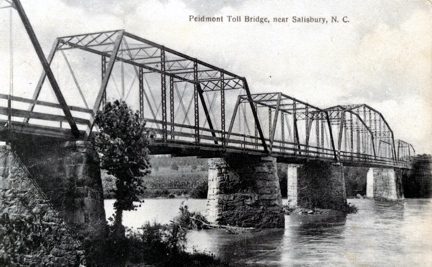
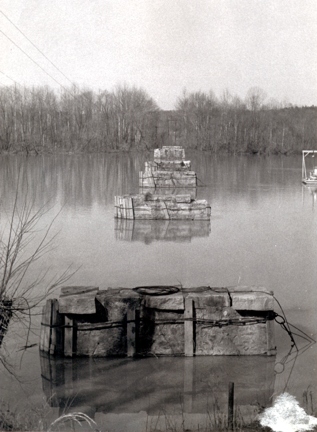
Long's Ferry and the Trading Ford. Unhappy with the high
prices Long charged for using his ferry, Beard contracted with Ithiel
Town for $30,000 to erect a bridge across the stream near where the
present Highway 29 crosses.
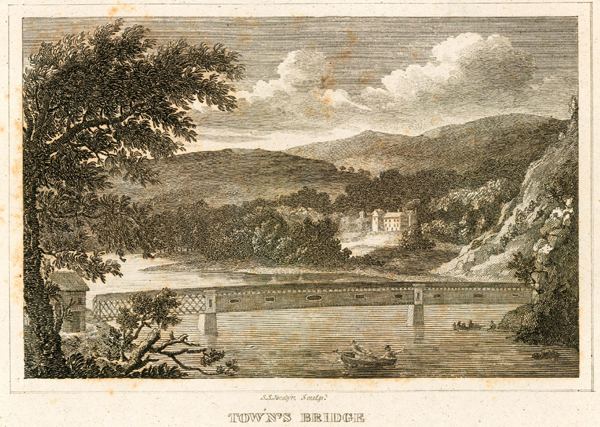
This
sawn-plank ''lattice'' truss bridge was Town's own invention and proved
unequal for simplicity, strength and symmetry. It was also
the most economical bridge that had been invented up to that time.
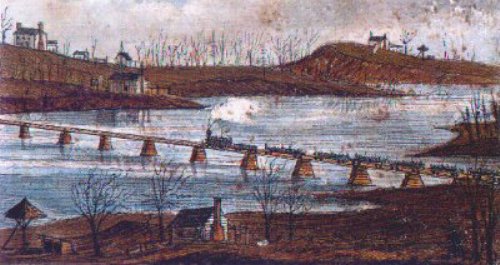
Two
years after Beard introduced Town to North Carolina, the city of
Fayetteville employed him to erect a bridge across the Cape Fear
River. In 1825 he was awarded an MA degree from Yale for his
innovative work and in that same year Camden, S.C. sought his talents
to erect a bridge over the Wateree.
Samuel
Lemly of Salisbury in 1825 using Town's design erected a bridge across
the South Yadkin River which drew admiring praise from the local
newspaper which called it ''as good as any in the South.''
When
in 1833 the state of North Carolina cast about for someone to draw
plans for a new capital at Raleigh to replace the one burned in 1831,
Ithiel Town was the best known architect in the country. He
and his partner Alexander Jackson Davis, were employed to draw the
design.