![]() |
|
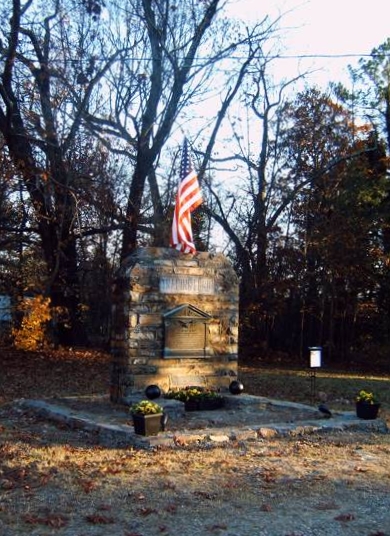
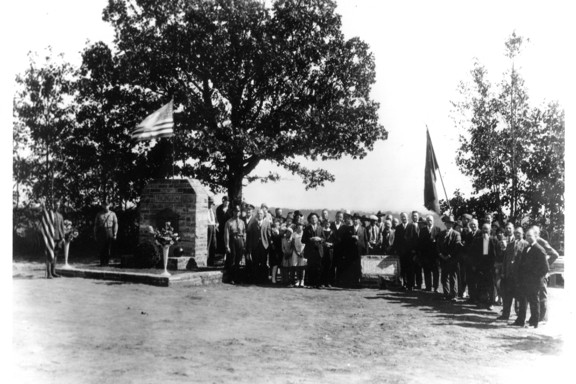
In 1929 the citizens of Davidson county NC dedicated this memorial to the role the Trading Ford played in the American Revolution. At that time, this monument was beside a busy main highway, atop a hill which looked down on the Trading Ford about half a mile distant. The view is now blocked by Interstate 85, the highway relegated it to a back road, and vandalism and neglect have all taken their toll on the once-proud remembrance, which undeterred keeps lonely vigil. |
|
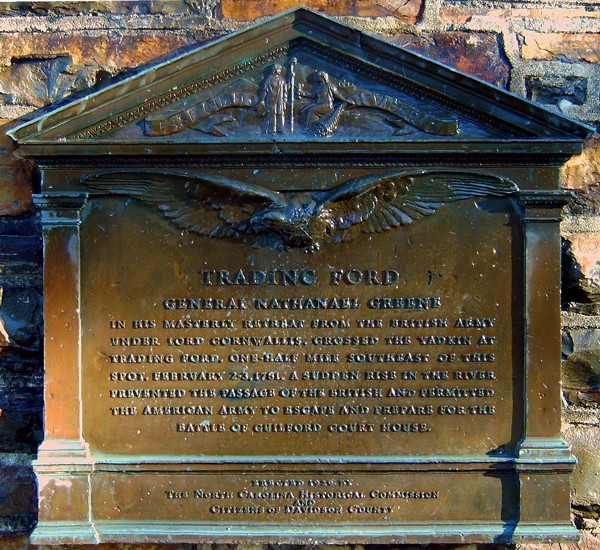
TRADING FORD GENERAL NATHANAEL GREENE IN HIS MASTERLY RETREAT FROM THE BRITISH ARMY UNDER LORD CORNWALLIS, CROSSED THE YADKIN AT TRADING FORD, ONE-HALF MILE SOUTHEAST OF THIS SPOT, FEBRUARY 2-3, 1781. A SUDDEN RISE IN THE RIVER PREVENTED THE PASSAGE OF THE BRITISH AND PERMITTED THE AMERICAN ARMY TO ESCAPE AND PREPARE FOR THE BATTLE OF GUILFORD COURT HOUSE |
Judge Parker, Rev. Mr. Sykes and Mr. Newsome Extol
Glories of Greene and His Patriot Band
With Judge John J. Parker, of the Federal circuit court of appeals, and Rev. Tom Alderman Sykes, of High Point, as outstanding speakers, the Trading Ford historic memorial was formally dedicated Saturday morning in the presence of a small but attentive gathering.
...
Judge Parker's Address
Speaking from the subject "North Carolina in the Building of the Nation," Judge Parker said in part: "We are met here today to dedicate this monument in commemoration of one of the important incidents of one of the most important campaigns of our struggle for independence. Greene's masterly retreat across North Carolina wore down the capacity for resistance on the part of the British commander and his army and paved the way for the victory at Yorktown. The crossing of the Yadkin at Trading Ford on February 3, 1781, when General Morgan's little [U.S.] army escaped from the army of the British as a result of the sudden rising of the river, was one of the dramatic and important incidents of that retreat. The hand of providence seems to have been stretched out to save our fathers, for it is hard to visualize what would have happened to the cause of the revolution if Morgan's army had fallen into the hands of the British here. The country was almost in despair as the result of Arnold's treason and the recent defeat at Camden [S.C.]. The defeat of Tarleton at Cowpens had revived the flagging hopes of the patriots, but, if in that battle, Morgan's army had been captured or destroyed, there would have been no battle of Guilford Court House with its demoralizing effect upon the British commander. It is entirely possible that there would have been no Yorktown. We of North Carolina are a modest people. We have allowed others to claim for themselves most of the glories of the Revolution. But we ought to take pride in the fact the closing scenes of the Revolution in which defeat was turned into victory, occurred here in North Carolina, and that the sons of North Carolina fought mightily in the achievement of the independence of America.
Greene's Retreat from Cornwallis
by A. R. Newsome, Secretary
The North Carolina Historical Commission
Late in 1778, the British, having failed in the North, and encouraged by reports of Loyalism in North Carolina, South Carolina, and Georgia, transferred the War on the South and overran Georgia and South Carolina by the summer of 1780. Sir Henry Clinton then sailed for New York, leaving [British General] Lord Cornwallis to complete the work in the South by the easy conquest of North Carolina and Virginia. North Carolina lay open to invasion - her resources exhausted, her organized forces sacrificed in the defense of South Carolina and Georgia. While Cornwallis delayed the invasion, North Carolina from sea to mountain was organizing, preparing for resistance, and harassing Tory bands with guerrilla warfare. Gates with his "northern laurels" was sent by Washington to command the [U.S.] Southern forces, only to have them turn to "southern willows" in the disaster at Camden in August [1780]. The next month Cornwallis set out for Charlotte, sending Ferguson to protect his left flank from the bands of western patriots. The hardy mountaineers under Campbell, Cleveland, Shelby, McDowell and others stormed and destroyed Ferguson in his refuge on King's Mountain October 7, and kindled anew the patriot cause everywhere. Cornwallis, who had found Charlotte a veritable "Hornet's Nest", fled hastily to Winnsboro, S. C.
In December, Washington placed Nathanael Greene in charge of the untrained scattered forces in the South. He drilled the troops, inspired morale, mapped and studied the country, and audaciously divided his force in face of the superior enemy by sending Huger to the Pee Dee region and Morgan west of the Catawba. Cornwallis, keeping the main army idle at Winnsboro, countered by sending Leslie to Camden and Tarleton to pursue Morgan. Morgan destroyed Tarleton's command at Cowpens on January 17, 1781; and hastened northward to withdraw from the reach of Cornwallis and to unite with the army of Huger and Greene.
A Masterly Retreat
Cornwallis, idle at Winnsboro and stung to unaccustomed energy by the Cowpens disaster, set out in hot pursuit of Morgan, reaching Ramseur's Mill on January 25. But Morgan had just crossed the Catawba at Sherrill's Ford, twenty-five miles away. Greene, learning of Morgan's victory and retreat, ordered Huger to move rapidly up the Yadkin and struck out across country to join Morgan. These two leaders planned the details of a great campaign: to draw Cornwallis as far as possible from his base of supplies, then turn upon and destroy the English. With perfect knowledge of the country, interposing obstacles in the path of the British, sharing the hardships with his men, Greene in his masterly retreat across the red hills of the piedmont Carolina in mid-winter, with Cornwallis in eager pursuit about twenty-five miles away, won a position high and secure in the military annals of the Revolution. In a desperate effort to overtake Morgan before he united with Huger, Cornwallis stripped his army of heavy baggage at Ramseur's Mill, crossed the Catawba, where occurred the sharp skirmish of Cowan's Ford, in which General Davidson lost his life, and reached the Yadkin on February 3, to find that Morgan had just crossed at Trading Ford. A slight rear guard engagement occurred in the night. An opportune rise in the river from heavy rains prevented the passage of the British. Unable to prevent the juncture of the two American armies, Cornwallis raced northward to seize the upper fords and prevent Greene's crossing the Dan; but the American leader eluded him by transferring the army by boats at Irwin's Ferry - a possibility overlooked by Cornwallis. Greene crossed the Dan on February 13 to await reinforcements. More than 200 miles from his base, in a hostile country in winter, without supplies, and no nearer the growing army of his enemy than at the beginning of the race, Cornwallis abandoned the pursuit and marched to Hillsboro to rest his army and rally the Tories. The hesitant Tories wished Cornwallis well but few enlisted, whereas Greene's army across the Dan was soon more than trebled by reinforcements and Whig volunteers to outnumber that of his opponent, more than half was raw militia which had never been in a battle. Greene re-crossed the Dan and skillfully drew Cornwallis westward. Both generals were eager for battle - Greene to damage if not defeat the English, the hard-pressed Cornwallis to win a necessary victory. On March 15, 1781, occurred the stubborn battle of Guilford Court House, in which Cornwallis gained a technical victory, though at the expense of 25 per cent of his entire strength. Though Greene lost more heavily and retreated leaving the British in possession of the field, Cornwallis, dismayed by the indifference of the Tories and too weak to resume the offensive or remain where he was, decided to establish contacts with the Tory Highlanders, the British army, and the British fleet by marching to Wilmington.
Cornwallis to Yorktown
Greene followed to Ramsey's Mill, then ignored Cornwallis and proceeded southward to recover South Carolina and Georgia. Arriving in Wilmington on April 7, Cornwallis was humiliated at the cold disregard of Greene and distressed at the dilemma in which he found himself. He could not remain idle in Wilmington. To go to Charleston where he had started in 1779 would be a confession of defeat. To Virginia he would go, join General Phillips for the conquest of the State, and return for the subjugation of North Carolina. He proceeded northward from Wilmington on April 25. To Yorktown he went, where, hemmed in by the French fleet and by Washington's army, he surrendered on October 19. It was the virtual end of the War of American Independence.
Of the brilliant campaign, Lord Germain wrote: "The rebels conduct their enterprises in Carolina with more spirit and skill than they have shown in any other part of America." Washington wrote to his gallant commander in the south, who had not only saved his own army, but led the enemy into a trap from which he extricated himself only with great disaster. "Your retreat before Cornwallis is highly applauded by all ranks."
Trading Ford Important
In that historic retreat Trading Ford is an important landmark.
Here it was that one of Greene's armies escaped from Cornwallis to join
with the other and finally deliver a blow at Guilford Court House which
paved the way to Yorktown.
![]() |
|
Two state historical highway markers in Rowan county remember the Trading Path and the Trading Ford. |